What to say when he finally texts back after going silent
He went quiet for days, then texted. Here is how to pick your tone, what to include, what to skip, and how to read where he goes next.
When a guy comes back after days of nothing, he is usually carrying a little awkwardness of his own. He knows the gap was noticeable. Maybe he got swamped at work, maybe he lost his nerve about what to say, maybe he drifted toward someone else and it fizzled. Whatever the reason, his first message tends to be short and low risk because he does not want to be told off. That smallness is not a verdict on his interest. It is a feeler.
Your goal is narrow. You are not trying to win the silence, punish it, or explain it away. You want a conversation that feels alive again within a few exchanges, and you want to find out whether he can hold up his end of it. A good reply sounds like someone with a full week who is glad to hear from him, not someone who spent three days refreshing the screen. Warmth, a little brevity, and one concrete hook do the heavy lifting.
Timing matters more over text than people admit. A reply that lands within a few hours reads as normal. A reply that lands in the middle of the night reads as either insomnia or heavy feeling, and a reply that lands two days later reads as a counterpunch. Texting also strips out tone, so a clipped answer can look cold and a gushing one can look anxious. Punctuation, emoji, and length all carry weight, so match the register he used rather than escalating past it.
Most things that backfire here come from the same impulse: trying to manage how he feels instead of moving the conversation forward. Questions about where he went, jokes with a barb hidden inside them, and long apologies for being busy all hand him the steering wheel. Sarcasm is especially risky because he cannot hear your voice, and a joke aimed at the silence can land as a complaint. Gushing relief does the opposite damage. It tells him the gap cost you something and cost him nothing.
His next message is your best evidence. If he picks up your hook, asks a follow-up, or suggests a plan, the silence was probably circumstantial and you can keep the same easy tone. If he answers in a few flat words and lets the thread sag, he is reading the room but not committing. If he drifts off again, you have learned something real without having to ask for it. Let that response, not your hopes, decide how much effort comes next.
Aim for warm, brief, and specific
Start by answering whatever he asked in a sentence, two at most. Then add a detail from your actual week, something small and particular, like a plan you have coming up or a thing you stumbled on. That detail gives him something to grab, which is the whole point. A reply built only from pleasantries leaves him nothing to respond to, and a reply that explains your feelings about the silence gives him far too much. Keep the energy a notch below his if he came in tentative. You want to sound glad he wrote, not rescued. Short paragraphs and a relaxed rhythm do more than clever phrasing.
Use a callback instead of a recap
Pull something from before he went quiet. A show he mentioned, a trip he was dreading, a joke you two shared. A light callback tells him you were paying attention without telling him you were waiting. It also quietly resets the conversation to the last place it felt good, which skips the awkward stretch entirely. Pick something low stakes and easy to answer. Avoid anything heavy, like a plan you were discussing that he never confirmed, because that drags the unresolved part of the gap right back onto the table.
Skip the explanation and the interrogation
Two instincts will pull at you. One is to explain why your reply took a few hours, which sounds defensive. The other is to ask what happened, which sounds like an audit. Both put the silence at the center of the thread. If he wants to explain himself, he will, and you can respond to that warmly when it comes. If he does not, you lose nothing. Also resist the urge to say you were busy too, as a kind of matching move. It reads as score keeping. Just reply like a person whose phone has not been the main event of the week.
Why these replies fail
“wow so you're alive, I was starting to think you fell off the planet”
The joke carries a complaint inside it, and over text he cannot hear whether you are teasing or stung, so he will assume stung.
“Hey! I'm so sorry I took a little while to answer, things have been crazy, hope you're doing well!!”
Apologizing for a short delay after he vanished for days flips the power, and the pile of exclamation points makes you sound relieved to be back in contact.
“Honestly it hurt a bit that you went quiet, can you tell me what happened?”
A confession plus a demand for an explanation turns his soft re-entry into a confrontation before the two of you have exchanged a single normal message.
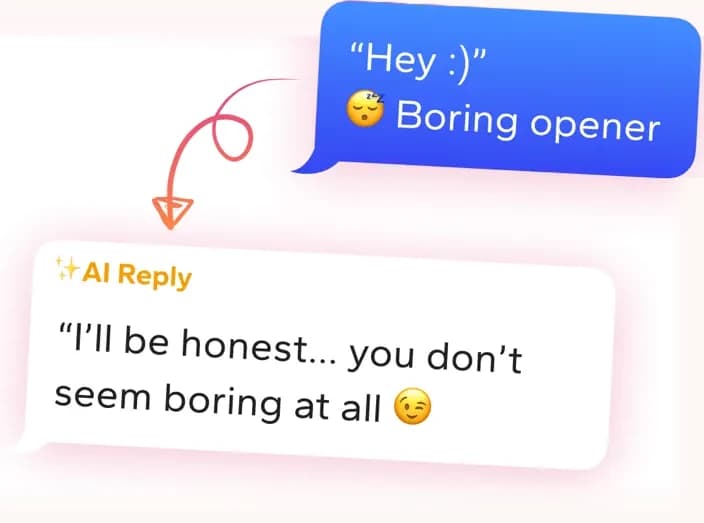
Get replies that sound like you
Screenshot the conversation in WingAI. It reads the vibe and gives you natural replies for this exact situation.
Try for freeQuestions people ask
- How soon should I reply when he texts after days of silence?
- Within a few hours is the right range, ideally while the day is still going. That reads as a normal response from someone with a life. Replying instantly looks like you were hovering, and waiting a day or more looks like a counterpunch he will notice.
- Should I match his short message or write something longer?
- Stay close to his length, then add one specific detail so there is something to respond to. If he sent four words and you send a paragraph, the imbalance is obvious. Slightly more than he gave, with a hook, keeps things easy without overinvesting.
- What if his message is just a meme or a one-word check-in?
- Respond to it lightly and add something of your own so the thread has somewhere to go. A bare check-in is low effort on his side, so do not rush to match it with enthusiasm. See whether he builds on what you offer or lets it stall.
- Is it okay to let him know I noticed he disappeared?
- Not in the first reply. Mentioning the gap puts him on the defensive and makes the conversation about your feelings before you have any new information. If the pattern repeats, you can say it plainly later. For now, let how you behave do the talking.
What users say
“I was skeptical at first. Then I tried it on a dry chat and the replies actually sounded like me, not a chatbot.”
Mazoonx
“She went cold mid-week and I had no idea what to say. The reply I sent felt natural and she picked the chat back up.”
Marcus T.
“I overthink every text. Having three options and picking the one that sounds like me cut that spiral short.”
Sam R.
Common mistakes
- Replying with a sarcastic jab about how long it took him, which he will read as hurt rather than humor since there is no tone of voice over text.
- Sending a long, detailed message packed with feeling when his was two lines, which makes the mismatch in effort impossible to miss.
- Reading his short opener as proof he does not care, and answering coldly before you have seen how he handles a warm, specific reply.
Get replies that sound like you
Screenshot the conversation in WingAI. It reads the vibe and gives you natural replies for this exact situation.
Try for free