Examples of dry messages and how to respond
Wondering what a dry message looks like? Learn the common patterns, why people send them, and how to write a reply that gives the chat a real pulse.
A dry message gives you nothing to hold. It might be a lone greeting, a shrug in text form, or an answer so clipped it closes the door it just opened. Examples include a bare hello, a reply that is only an acknowledgment, or a single word after you wrote a paragraph. The common thread is missing effort and missing hooks, not missing interest.
On the other end of the screen, the person is often in a smaller headspace than you imagine. They may be mid-commute, half watching a show, or staring at a blank text box worried that anything longer will sound try-hard. Some people treat texting as logistics only and save their personality for voice calls or in-person time. A flat message from them says more about how they handle a keyboard than how they feel about you.
Your aim is to make replying cheap for them. Dry texters rarely refuse conversation; they refuse the work of inventing it. So the approach is to hand them something concrete and low-stakes: a callback to a detail they dropped earlier, a playful take on something in their profile, or a small story from your own day that begs a reaction. Keep the tone warm and a little amused, never needy. Aim for something short enough to read in a glance, with one clear thing to answer.
Timing matters more than people admit. On Hinge or Tinder, a match who sends a flat opener at midnight is probably winding down, and a thoughtful reply at breakfast lands better than a frantic one right away. A same-day answer keeps the thread alive, but sending three follow-ups before they respond reads as pressure. Match their rhythm loosely, then pull it slightly upward.
What backfires is commentary on their dryness. Pointing out that they are boring, asking why they are so quiet, or sighing in text form makes them defensive and gives them an easy reason to vanish. Over-apologizing for your own long messages fails for a similar reason. So does interrogating them with stacked questions. Read their next move instead. If they match your energy with even a little detail, ease into it. If they answer in a few words again, try one more specific angle, then let it rest and watch whether they ever reach toward you.
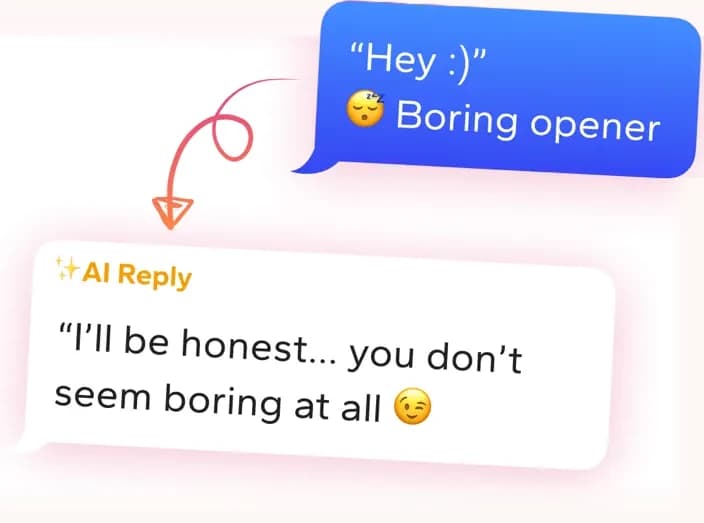
Get replies that sound like you
Screenshot the conversation in WingAI. It reads the vibe and gives you natural replies for this exact situation.
Try for freeSpotting dry messages in the wild
Dry messages come in recognizable shapes. The bare greeting opener is the classic, but there are quieter versions. A reply that mirrors your last word back without adding anything. A thumbs up where a sentence should be. An answer to your detailed question that is one word long, with no question returned. Even a polite response can be dry if it hands you zero material. Watch for the missing return serve: if every message ends with a period and nothing else, you are doing all the lifting. Compare it to how they text on a good day. Someone who normally sends full thoughts and suddenly goes clipped is probably busy or off, which is different from someone who has never sent more than three words.
Choosing an angle that gets answers
Pick a hook that is easy to answer and specific to them. A light callback works well: reference something from earlier in the chat or their profile and ask for the story behind it. An observation with a touch of humor also works, especially about a photo or an interest they listed. Another option is sharing a small, vivid detail from your own day and letting them react. Keep it short, one idea only, and end on something they can respond to in a sentence. Avoid broad openers about their week or their plans, because those invite the same flat answer you just received. Tone should be relaxed and curious, like you are mildly entertained, not like you are conducting an interview.
Reading what comes back
Their next message tells you how to proceed. If they respond with a real detail or a question of their own, follow that thread and let the energy build naturally. If they respond warmly but briefly, they may simply be a low-volume texter, so consider suggesting a call or meeting instead of forcing paragraphs. If they come back dry again, try a single different angle rather than repeating yourself louder. After that, step back and give the conversation room. Someone who is interested will usually surface with something, even a small something. Someone who stays flat after two honest attempts is telling you where they stand, and chasing further costs you more than it earns.
Questions people ask
- What is an example of a dry message?
- A dry message is a text that offers nothing to respond to, such as a bare greeting, a one-word acknowledgment, or a flat answer with no question back. It lacks detail, personality, and any hook. It often reflects low effort or nerves, not necessarily low interest.
- What should I say when a conversation gets dry?
- Shift to something specific and easy to answer. Reference a detail they mentioned earlier, share a small story from your day, or ask about one concrete thing in their profile. Skip broad questions about their week. Keep it short, friendly, and curious, with one clear thing for them to respond to.
- Does a dry text mean they are not interested?
- Not by itself. People text dry when distracted, nervous, or simply bad at messaging. One flat reply tells you little. Watch the pattern over several exchanges, especially whether they ever add detail or ask you something back after you put in real effort.
- How long should I wait before replying to a dry message?
- A gap of a few hours is fine and often better than an instant reply, since it keeps you from looking eager or matching their low effort. Reply the same day when you can. Avoid sending several follow-ups before they answer, because that adds pressure to an already thin exchange.
Why these replies fail
“Why are you so dry lol”
Naming their texting style as a flaw makes a shy or distracted person feel judged, so they tend to retreat further instead of loosening up.
“Hey! How are you? What are you up to? Do you work or study? What do you like to do?”
A pile of generic questions turns a flat exchange into an interview, and they can answer each with one word while you do all the work.
“Sorry if I'm texting too much, I know I talk a lot”
Apologizing for effort after a dry message makes your energy look like a burden and invites them to match the lower level you just offered.
Common mistakes
- Answering a flat message with another flat message, which confirms the conversation has no direction and leaves both people waiting for the other to start.
- Commenting on their low effort in text, which puts them on the defensive and turns a texting habit into a character judgment.
- Firing off a stack of questions to compensate, which gives them an easy excuse to answer only the shortest one and ignore the rest.
What users say
“I was skeptical at first. Then I tried it on a dry chat and the replies actually sounded like me, not a chatbot.”
Mazoonx
“I overthink every text. Having three options and picking the one that sounds like me cut that spiral short.”
Sam R.
Get replies that sound like you
Screenshot the conversation in WingAI. It reads the vibe and gives you natural replies for this exact situation.
Try for free