Tell if he's ghosting or just busy in early dating
Learn to spot the difference between ghosting and actual busyness, and how to reply without seeming desperate or needy.
In the first month or two, slow replies don't always mean he's lost interest. Work, life stress, or just phone habits can slow someone down. But there are patterns that separate actual busyness from the slow fade. The gap between messages matters. So does whether he engages with what you actually said, or just throws back surface-level stuff.
Your reply here does two jobs at once. It gives him a real reason to engage again, without making it look like you're chasing. And it subtly tests whether he'll actually come back. A good reply also buys you time. You're not waiting passively for his next move. You're setting a new frame where he has to decide if he wants back in.
Get replies that sound like you
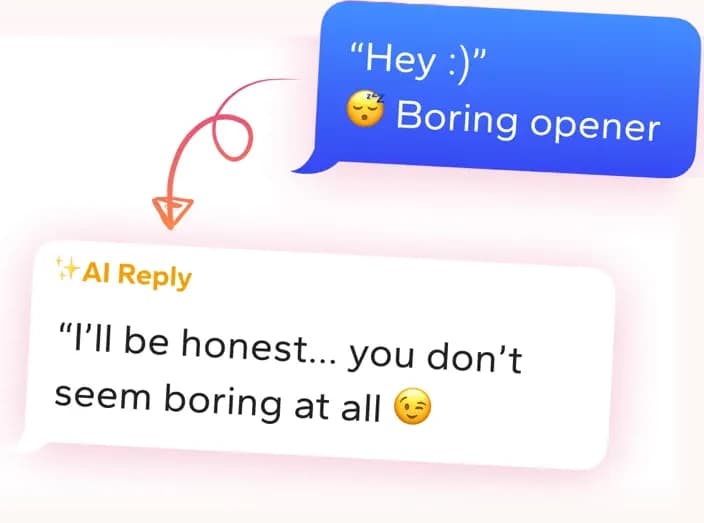
Screenshot the conversation in WingAI. It reads the vibe and gives you natural replies for this exact situation.
Try for freeRizz AI Screenshot the chat and get the next message for this person.
The response time pattern tells you everything
Actual busyness has a shape. He replies slower, but when he does, he still engages. He might take 8 hours instead of 2, or a day instead of the same day. But he's still responding to what you said and adding something new to the conversation.
Ghosting has a different pattern. Messages get shorter. He stops asking questions. Replies become one word or just a reaction emoji. The momentum dies gradually. Another sign: he was quick to reply in the first week, then suddenly disappeared. That shift matters more than slow replies from the start. If he was slow from day one, that's just how he texts. If he was fast and flipped to nothing, he's not busy. He's checking out.
Match his effort level without chasing him
Your reply should not be longer or more engaged than what he's been sending. If his last few messages have been short, match that tone. If they've been thoughtful, you can too. The goal is to give him an opening that costs him nothing to take. Make it easy for him to respond in a normal way, not a way that requires effort.
Don't ask multiple questions. Don't bring up something heavy or relationship-focused. Just land one clear point that relates to something he'd actually care about, or toss a small real question that he can answer in a sentence. Then step back. You're testing if he wants to keep talking, not convincing him that he should.
Wait a full week before you assume he's done
Send your reply once. Then wait the full week to see what happens. If he comes back before day five, he was probably just busy. If it takes until day six or seven, that's a mixed signal. If there's nothing by day eight, stop waiting.
During that week, don't keep checking your phone. Don't send anything else. Don't like his Instagram posts or respond to his stories. Let the silence tell you what you need to know. If he's interested, he'll make space to reply. If he doesn't, you have your answer. After a week of silence, move on. A second message after that just confirms to him that you're more invested than he is.
Why these replies fail
“Heyy, feel like I'm annoying you lol. Just wanted to check in!”
The self-deprecation signals insecurity and makes him feel awkward, so he's less likely to reply.
“Got it, no worries. Whenever you're free :) Just let me know”
This removes any reason for him to step up and reach out. You've already given him a free pass to disappear.
“Don't worry about me, I know you're busy. But I'd love to actually hang out soon if that works for your schedule”
It's too understanding and too focused on seeing him. You're showing up as the chaser, not someone he has to earn back.
Common mistakes
- Double texting immediately after he doesn't reply, which signals you're waiting around
- Asking what's wrong or why he vanished, which puts pressure on him to explain
- Sending something super casual to 'keep it light', which he can ignore without consequence
- Waiting more than a week before saying anything, which lets him think you don't care
- Apologizing or toning yourself down to make yourself easier to reply to
Questions people ask
- How long should I wait before deciding he's ghosting?
- A full week. If he hasn't replied by day 8 after your message, he's signaling he's not interested. Anything before that is still in the unclear zone. Waiting longer just wastes your time and energy on someone who isn't reciprocating.
- Should I call him out for going quiet?
- No. Calling out silence puts him on the defensive and gives him an easy exit. He'll either make an excuse or disappear faster. Instead, send something low-pressure that gives him a way back in without needing to explain himself first.
- What if he's always been a slow texter?
- If he was slow from the start and still engaged when he did reply, that's just his communication style. Wait longer than you would for someone faster. But if he goes from engaged to one-word replies, that's the real signal. Speed matters less than drop-off.
- Is it worse to seem needy or to let him fade?
- Letting him fade. Seeming needy pushes him away harder. Your best move is to send something that shows you're present but not waiting around. Then actually don't wait around. Move on if he doesn't step up within a week.
What people say after using WingAI
“She went cold mid-week and I had no idea what to say. The reply I sent felt natural and she picked the chat back up.”
Marcus T.
“I overthink every text. Having three options and picking the one that sounds like me cut that spiral short.”
Sam R.
“I was skeptical at first. Then I tried it on a dry chat and the replies actually sounded like me, not a chatbot.”
Mazoonx
Get replies that sound like you
Screenshot the conversation in WingAI. It reads the vibe and gives you natural replies for this exact situation.
Try for free