How to tell her she feels like a backup plan
Address feeling deprioritized without accusing her. Learn when and how to name the pattern clearly.
You're noticing a rhythm. She reaches out when it's convenient for her, goes quiet when something better comes up, or takes hours to reply while you respond fast. You feel lower on her priority list than she is on yours. The question is whether to say it and how.
A good reply here does two things. It names what you're actually observing without making her defend herself, and it creates space for her to either step up or step back. You're not asking for reassurance. You're signaling that you see the imbalance and won't pretend it isn't there.
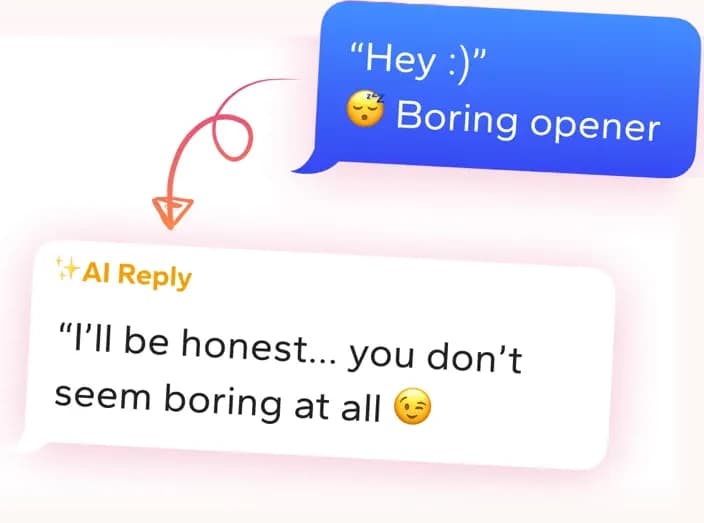
Get replies that sound like you
Screenshot the conversation in WingAI. It reads the vibe and gives you natural replies for this exact situation.
Try for freeRizz AI Screenshot the chat and get the next message for this person.
The pattern of reach outs versus response time
When she makes you feel like a backup plan, there's usually a specific pattern. She texts you when she's bored or has freed up time. Her replies come hours or days after you message. She cancels or flakes more than she follows through. She's reactive toward you, not proactive. This isn't about one slow reply or a busy day. It's a rhythm that repeats across weeks. Before you say anything, make sure you've actually seen the pattern twice, not once. One cancellation isn't a pattern. Regularly texting you after 10pm while ignoring daytime messages is.
Name the specific behavior, not the feeling
The move is to describe what you're seeing without interpretation. Instead of 'you make me feel like a backup plan,' try 'I've noticed you text me late at night but are hard to reach during the day.' You're not accusing her of intentionally deprioritizing you. You're stating the observable fact. She can't argue with what happened. What she does next tells you everything. A good reply stays calm and specific. It mentions the actual behavior (response time, initiation patterns, flaking frequency) rather than asking her to validate your worth or promise she values you. Let her actions prove she's shifted, not her words.
Send it when you're calm and expect silence
Timing matters more than wording here. Don't send this when you're mad, lonely, or late at night. Send it when you've had time to think clearly, ideally in daylight. Expect her to either not reply for a while or to get defensive. Neither means you said something wrong. If she goes quiet, don't chase. You've made your point. If she replies with 'I'm just busy' or 'that's not fair,' that's her showing you who she is. Wait to see if the pattern actually changes over the next two weeks. If nothing shifts after you've named it once, you have your answer. Don't bring it up again. Just decide if you want to keep dating someone who hasn't changed.
Why these replies fail
“Do you even think about me when we're not talking? Because it doesn't feel like it.”
It's a question disguised as a complaint, which forces her into a defensive reassurance conversation instead of addressing the actual behavior.
“You texted me at 11pm last Tuesday, then didn't reply for 16 hours on Wednesday, and you were late to plans on Saturday. I'm done being treated this way.”
Listing grievances makes this sound like an accusation and a breakup threat rather than a calm observation, which shuts down any real conversation.
“I feel like maybe I'm not that important to you and that's cool, I just wanted to mention it so you know how I feel”
This is soft and apologetic, which actually protects her from hearing the message and makes it easy for her to dismiss what you're saying.
Common mistakes
- Asking 'am I a backup plan?' makes her reassure you instead of changing behavior
- Listing all the times she deprioritized you sounds like a complaint, not a boundary
- Sending it after midnight when you're frustrated makes you look reactive
- Phrasing it as a question instead of an observation lets her dodge the point
- Following up immediately if she doesn't reply gives her the power to ignore you
Questions people ask
- What if she says she's just busy or stressed?
- Busy explains one cancelled plan or a slow week. It doesn't explain a months-long pattern of reaching out late at night but ignoring daytime messages. You can acknowledge she's busy while still saying you need someone more available. Then watch whether her behavior changes. Words about being stressed mean nothing without action.
- Should I bring this up in person or over text?
- Text is actually better here. It gives her time to process without having to react on the spot, and it keeps the conversation focused on the behavior instead of turning into an emotional discussion. In person, she can deflect with tone or charm. Text forces clarity.
- What if I'm wrong and she actually does care?
- If she actually cares, she'll respond to this by changing. She'll initiate more. She'll reply faster. She'll make plans and keep them. You're not asking for grand gestures, just for her to show up differently. If her response is only words and nothing shifts, she didn't actually care enough to change.
- How long should I wait for her to prove she's changed?
- Two to three weeks. That's enough time for a new pattern to show. If after two weeks you're still seeing the same rhythm, nothing has changed. Don't wait longer for someone to prove they want to be with you. If she hasn't shifted by then, she won't.
What people say after using WingAI
“I was skeptical at first. Then I tried it on a dry chat and the replies actually sounded like me, not a chatbot.”
Mazoonx
“Used it for a couple hours and set up a date the same night. Not even kidding.”
Nikola2214
“My openers used to be boring. Now I reference something from her profile and people actually write back.”
Aiden K.
Get replies that sound like you
Screenshot the conversation in WingAI. It reads the vibe and gives you natural replies for this exact situation.
Try for free