Fix a dry text conversation and get her engaged again
Texts gone flat? See why your questions keep landing as an interview, how to change the pattern, and when to stop pushing and let the chat rest.
Picture her side of a dry thread. She opens her phone between meetings or on the couch, sees another question, and types the shortest answer that is still polite. That is not coldness. It is what a person does when each message hands her a small task and gives her nothing to play with. She answers, then waits for the next task. Nobody enjoys being quizzed, and a chat that feels like intake paperwork produces exactly the clipped replies you are seeing.
Your aim is to make replying feel optional and easy rather than owed. That means changing what your messages contain. A remark about something she mentioned earlier, a small detail from your own day, a half-formed opinion about a film or a neighbourhood: these give her material to react to without a deadline attached. You are not trying to be funnier or more impressive. You are trying to stop sounding like a form she needs to complete.
Timing matters more over text than people admit. A message sent late at night to someone winding down lands differently from one sent during her lunch break. If she tends to reply in bursts, a rapid volley of your own messages will overwhelm the one window she gives you. If her replies are slow and short, doubling up makes the silence feel louder. Match the rhythm she already has, then add substance within it. Sending a single well-built message and then leaving it alone is usually stronger than three nervous follow-ups.
What tends to backfire is anything that draws attention to the dryness itself. Asking whether she is bored, joking about her short answers, or announcing that you will stop texting so much all force her to manage your feelings, which is more effort than the original chat required. Overcorrecting is just as bad: dumping a long story about your week turns her into an audience and the exchange into a monologue. Keep what you share small enough that she can pick up one thread of it and ignore the rest.
Reading her response comes down to texture, not speed. A reply that picks up something you said, even clumsily, tells you the door is open. A reply that adds a detail you did not ask for is better still. If she answers your new message with the same flat acknowledgment as before, try once more with something different in kind, then give it room. A conversation that only moves when you push it was never going to carry a date, and you will learn that sooner by stepping back than by pressing harder.
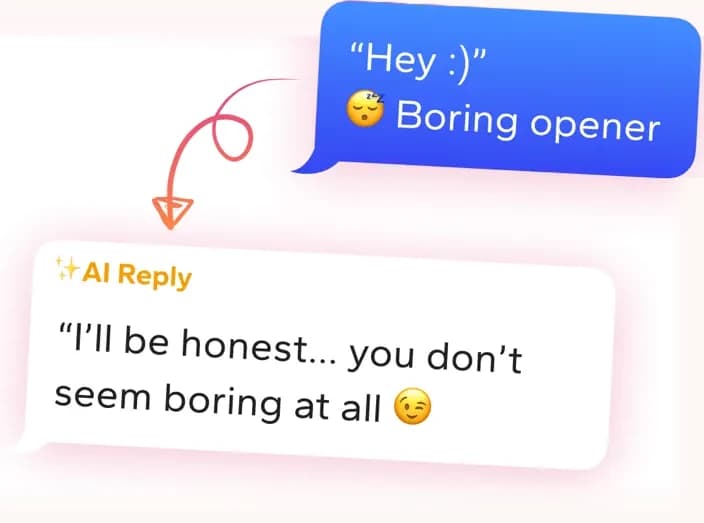
Get replies that sound like you
Screenshot the conversation in WingAI. It reads the vibe and gives you natural replies for this exact situation.
Try for freeWhy short replies feel polite to her
A one-word reply is often a courtesy. She does not want to ignore you, but she has nothing sparked in her to say, so she gives the minimum that keeps things civil. Treating that as rejection leads you to chase harder, which adds more pressure and shrinks the answers further. Look at what your last three messages asked of her. If each one required her to produce information from scratch, the brevity is a response to workload. Her mood, her day, and her interest all matter, but the format is the part you control right now. Change the shape of what you send before drawing conclusions about her.
Building from something she already said
Go back through the thread and find a detail she dropped without emphasis: a trip she mentioned, a complaint about her commute, a show she was halfway through. Comment on it with a thought of your own instead of asking her to explain. Because it grows out of her words, it proves you were listening, and it asks nothing of her except a reaction. If she gave you very little, use a shared context instead, like something about the city you both live in or an event happening this week. The point is that the message has a reason to exist beyond filling the silence.
Knowing when to leave it alone
After you change your approach, give her a full day or two before judging the result. People reply late for dull reasons, like a bad week or a phone left in a bag. If your shifted message still gets a thin answer, send one more that stands on its own and does not need a response. Then stop initiating for a while. Stepping back is not a tactic to provoke her. It simply stops you from stacking effort onto a thread that is not returning any. If she comes back with energy, follow her pace. If she does not, you have your answer without having pleaded for it.
Why these don't work
“Why are you being so dry today?”
It turns her short replies into a charge against her, so she either apologises or pulls back further, and neither gives you a livelier chat.
“Tell me literally everything about your week, I want to hear it all!”
A huge open request asks her to do the most work at the moment she has the least energy, so she will likely answer with a polite sentence and move on.
“Hello? Did I say something wrong?”
Chasing a quiet thread with a message that needs reassurance puts her in the position of managing your worry, and it makes the next reply feel like an obligation.
Pitfalls to avoid
- Firing off a fresh question every time she goes quiet, which locks the chat into interview mode and teaches her to wait for prompts.
- Commenting on how short or slow her replies are, which makes her feel monitored and usually produces even less.
- Swinging the other way with a long wall of text about yourself, so the exchange becomes a lecture she has to sit through.
People also ask
- Why does my text conversation keep going dry?
- Usually because most of your messages are questions, so she answers and waits for the next one. A chat needs material she can react to, like an observation or a small detail from your day. Mixing in statements that tie to what she said gives her something to build on instead of another task.
- How long should I wait before texting again after a dead reply?
- A day or two is reasonable. Waiting longer lets the thread go cold, while messaging within hours of a flat reply looks like pressure. Send something that stands alone and needs no answer. If it lands badly, hold off and let her come to you before you try again.
- Should I ask her out if the texting is dry?
- Only if there has been some real back and forth first. A thin thread can still lead to a date if she has shown interest in other ways, but asking out of frustration reads as pressure. Warm the exchange up with one or two livelier messages, then suggest meeting in a low-stakes, specific way.
- What do I do if she only replies with one word?
- Stop sending questions. Send one message with a thought or observation that does not demand an answer, then wait. If you get another one-word reply, send a single standalone follow-up and pause. Repeated flat responses tell you she is not in the mood for texting, so stop pushing.
It doesn't sound like a bot
“I always freeze on the first sentence. This gets me past that blank box so I actually hit send.”
joejoe4567
“I was skeptical at first. Then I tried it on a dry chat and the replies actually sounded like me, not a chatbot.”
Mazoonx
Get replies that sound like you
Screenshot the conversation in WingAI. It reads the vibe and gives you natural replies for this exact situation.
Try for free